Understanding how the SAT is scored can help you set realistic goals, interpret practice-test results, and use an SAT score calculator correctly. This guide explains the SAT scoring system, Digital SAT scoring, raw versus scaled scores, percentiles, missed questions, and common SAT score questions.
How Is the SAT Scored?
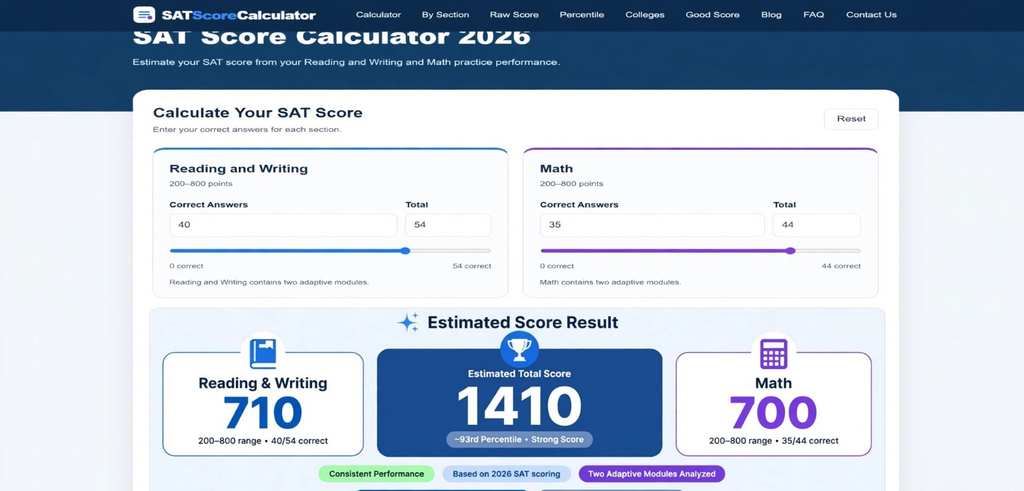
The SAT has a total score range of 400–1600. The total score is made up of two section scores:
- Reading and Writing: 200–800
- Math: 200–800
Your total SAT score is the sum of your Reading and Writing score and Math score.
Because the Digital SAT is adaptive, the number of questions you answer correctly does not translate into one universal scaled score for every student.
How Does the Digital SAT Scoring Work?
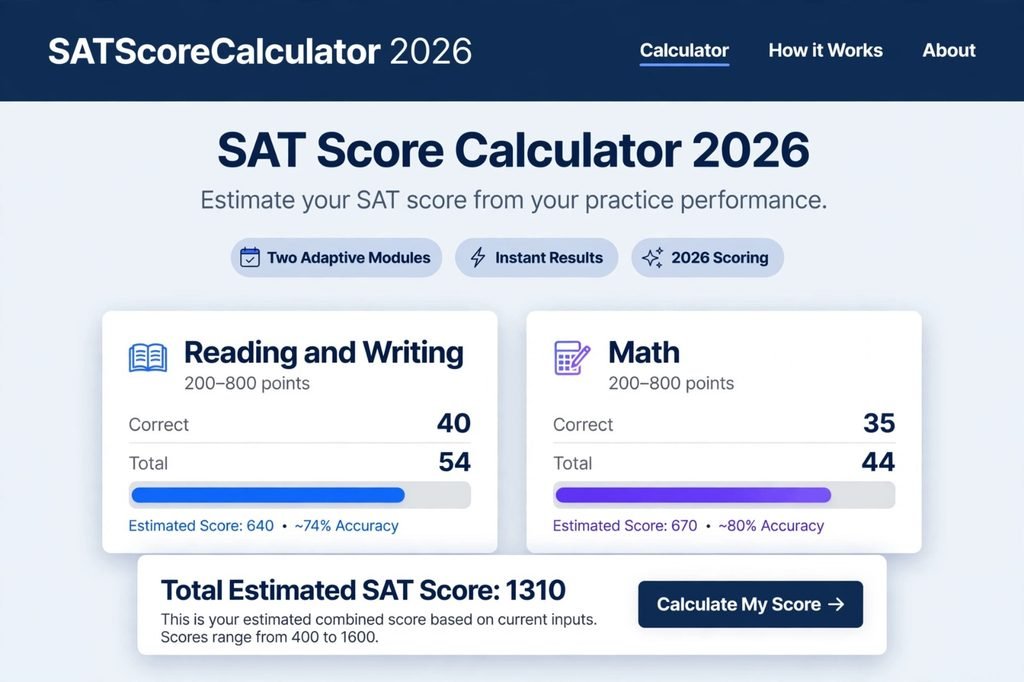
The Digital SAT uses an adaptive testing system. The test has two sections: Reading and Writing and Math. Each section is divided into two modules.
Performance on the first module affects the difficulty level of the second module. Your final score is calculated using your responses and the characteristics of the questions you answered.
This means two students who answer the same number of questions correctly may not necessarily receive exactly the same score.
What Is the Highest SAT Score?
The highest possible SAT score is 1600.
A perfect SAT score consists of:
- 800 in Reading and Writing
- 800 in Math
A 1600 represents the maximum score available on the SAT.
What Is the Average SAT Score?
The average SAT score depends on the specific group and reporting year being considered.
When discussing an average SAT score, always identify the relevant student population and year rather than assuming one number applies to every group.
Your own score should also be compared with the colleges you are interested in.
How Many Questions Can You Miss to Get a 1400?
There is no fixed number of questions you can miss and always receive a 1400 on the Digital SAT.
The Digital SAT is adaptive, and scoring depends on factors beyond simply counting correct and incorrect answers.
For this reason, an SAT score calculator should provide an estimate rather than promising that a specific number of missed questions always produces a 1400.
How Many Questions Can You Miss to Get a 1500?
There is no universal number of missed questions that guarantees a 1500.
The final Digital SAT score depends on your performance across the modules and the characteristics of the questions you answer.
For practice purposes, focus on accuracy and understanding your mistakes instead of targeting a fixed number of questions to miss.
SAT Score vs. Percentile
Your SAT score and SAT percentile are different measurements.
Your SAT score is reported on the SAT scoring scale, while your percentile shows how your score compares with scores from a particular comparison group.
For example, a student can have a specific SAT score and then use percentile information to understand how that score compares with other test takers.
SAT Score Calculator Guide
An SAT score calculator is designed to help students estimate or understand their SAT results.
Depending on the calculator, it may include:
- Total SAT score
- Math score
- Reading and Writing score
- Estimated score from practice questions
- Raw-to-scaled score conversion
- Percentile information
- College score comparisons
Always check whether a calculator is designed for the current Digital SAT or an older SAT format.
How Does the SAT Score Calculator Work?
An SAT score calculator generally takes information such as section performance, correct answers, or practice-test results and uses a scoring method to estimate a scaled score.
The exact calculation method depends on the calculator.
Because official Digital SAT scoring is more complex than simply converting the number of correct answers into a fixed score, third-party calculators should be treated as estimates.
How Is the Digital SAT Score Calculated?
The Digital SAT produces separate Reading and Writing and Math section scores.
Each section contributes up to 800 points to the total score, giving a maximum total of 1600.
The adaptive nature of the test means that score calculation is not simply:
Number correct × fixed points = SAT score
Instead, the scoring process takes the test’s adaptive structure and question characteristics into account.
How Many Questions Can You Miss on the SAT?
There is no single number of questions you can miss and still receive a particular score.
The answer depends on:
- Which section you are taking
- Which questions you answer incorrectly
- The difficulty characteristics of those questions
- Your performance across the test modules
Therefore, missed-question estimates should be treated as approximate rather than guaranteed.
How Many Questions Can You Miss to Get a 1200 SAT Score?
A specific number of missed questions cannot guarantee a 1200 on the Digital SAT.
Instead of using a fixed missed-question target, use official practice tests to see how your performance translates into scores and identify the areas where you lose points.
How Many Questions Can You Miss to Get a 1300 SAT Score?
There is no fixed missed-question number that guarantees a 1300.
Your score depends on how you perform across the Reading and Writing and Math sections and on the adaptive scoring process.
Use practice tests and score reports to develop a more realistic estimate of your expected score.
How Many Questions Can You Miss to Get a 1400 SAT Score?
A 1400 cannot be tied to one universal number of incorrect answers.
Because the Digital SAT is adaptive, students should focus on maximizing correct answers and improving weak content areas rather than trying to calculate exactly how many questions they can miss.
How Many Questions Can You Miss to Get a 1500 SAT Score?
There is no guaranteed number of missed questions for a 1500.
A student targeting 1500 should aim for very strong performance across both sections and use official practice tests to measure progress.
How Many Questions Can You Miss to Get a 1600 SAT Score?
A 1600 is the maximum SAT score.
Aiming for 1600 means aiming for exceptionally strong performance across both Math and Reading and Writing. However, the Digital SAT does not use a simple fixed rule where every missed question automatically reduces your score by a predetermined number of points.
How SAT Math Scores Are Calculated
The SAT Math section contributes between 200 and 800 points to your total SAT score.
The Digital SAT Math section contains two modules, and performance on the first module influences the difficulty of the second module.
Your Math score is then reported on the 200–800 section-score scale.
How Are SAT Math and Reading and Writing Scores Calculated?
The SAT reports two section scores:
Math: 200–800
Reading and Writing: 200–800
Your total SAT score is calculated by adding the two section scores.
For example:
Math 700 + Reading and Writing 650 = Total SAT Score 1350
How Can I Improve My SAT Score?
Improving your SAT score starts with identifying the areas where you are losing points.
Try to:
- Take a full-length practice test.
- Review every incorrect answer.
- Identify recurring weaknesses.
- Practice those topics regularly.
- Improve your timing and test-taking strategy.
- Take another practice test.
- Compare your results and adjust your study plan.
Consistent practice and reviewing mistakes are more useful than simply taking practice tests without analyzing your performance.
SAT Score Calculator FAQs
What Is a SAT Score Calculator?
An SAT score calculator is a tool that helps estimate, calculate, or interpret an SAT score based on information such as section performance or practice-test results.
How Does the SAT Score Calculator Work?
The calculator uses the information you enter and applies a scoring or estimation method to produce a result. Different calculators may use different methods, so results should be treated as estimates unless the calculator is based on official scoring information.
How Is the SAT Score Calculated?
The SAT total score is made by combining the Reading and Writing and Math section scores. Each section ranges from 200 to 800, producing a total range of 400 to 1600.
What Is the Maximum SAT Score?
The maximum SAT score is 1600.
What Is the Minimum SAT Score?
The minimum possible SAT score is 400.
What Is the SAT Score Range?
The total SAT score range is 400–1600. Each of the two section scores ranges from 200–800.
Can I Calculate My SAT Score From the Number of Correct Answers?
You can use the number of correct answers to estimate performance, but there is no single universal correct-answer-to-score conversion for the Digital SAT.
The adaptive format means that the final score is not determined by simply multiplying correct answers by a fixed number of points.
What Is the Difference Between Raw Score and Scaled Score?
A raw score generally refers to the number of questions answered correctly, while a scaled score is the score reported on the SAT’s scoring scale.
For the Digital SAT, you should not assume that a fixed raw score always produces the same scaled score.
How Accurate Is a SAT Score Calculator?
Accuracy depends on how the calculator is designed and what scoring information it uses.
A calculator that estimates scores from question counts may not exactly reproduce an official SAT score. Use official score reports and official practice tests when accuracy is important.
Can I Use the Calculator for the Digital SAT?
Yes, but make sure the calculator specifically supports the Digital SAT.
Older SAT calculators may use scoring assumptions that do not accurately represent the current adaptive SAT.
How Many Questions Can I Miss and Still Get a 1400?
There is no fixed number of questions you can miss and still guarantee a 1400. Digital SAT scoring depends on the adaptive testing structure and the characteristics of the questions.
How Many Questions Can I Miss and Still Get a 1500?
There is no universal missed-question number for a 1500. Your score depends on your performance across the Digital SAT modules and the scoring process.
What Is Considered a Good SAT Score?
A good SAT score depends on your college goals.
A score that is competitive for one college may be less competitive for another. Compare your score with the current information for your target schools.
What Is an Average SAT Score?
An average SAT score depends on the student population and reporting year. When using an average as a benchmark, make sure the data applies to the group you are comparing yourself with.
What SAT Score Do I Need for College?
There is no single SAT score required for every college.
The appropriate target depends on the college, program, admissions policy, and applicant pool. Check each college’s current official admissions information.
Can I Calculate My SAT Percentile?
Yes. You can use an SAT percentile calculator or an appropriate percentile table to estimate how your SAT score compares with a particular comparison group.
Does the SAT Score Calculator Show Section Scores?
Some SAT score calculators show separate Math and Reading and Writing scores, while others only provide an estimated total score.
Check the calculator’s features before using it.
Does the SAT Score Calculator Work for Practice Tests?
It can be used for practice-test estimation if the calculator is designed for that particular test format.
For the most reliable practice score information, use official Digital SAT practice tests and their associated scoring information.
How Can I Improve My SAT Score?
Start by identifying your weakest topics and question types. Review mistakes, practice consistently, take timed tests, and track your progress over time.
The goal should be to improve your underlying skills rather than simply memorizing a score conversion.